thelifediy.com
Random Posts
LOAD MORE
Homelab: 4 Family & apartment friendly server cabinet
A practical homelab cabinet build that makes multiple tiny servers easier to live with in an apartment or family setting.
Easy Naim Hi-Fi power amp upgrades
A straightforward set of component upgrades that can noticeably improve older Naim power amps and similar hi-fi amplifiers.
Pedal Progression: 1 Range Master
Pedal Progression starts with a rebuilt Range Master treble booster using vintage parts, protection circuitry, and a polished new housing.
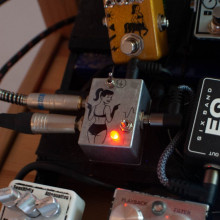
Guitar Pedals: 2 Splitter/Buffer
A compact splitter/buffer build for running two guitar heads at once, with practical fixes to the original circuit values.
Guitar Pedals: 2 Splitter/Buffer
A great little utility box that on its own can have a massive influence on sound, since it allows me to play through two separate guitar heads at the same time! I also challenged myself building it into the absolute smallest package possible, using separate pcbs and retaining key options of ground-lift and a phase switch.
Right up front I want to clearly communicate that an absolutely required mod to the base schematic is to increase coupling caps, the original schematic has them set so low they only allow for the absolute tiniest and most restrictive conception of what a guitar sound should be, completely unusable in my opinion. That did come as a surprise since I based this on an old classic, the Runoffgroove splitter and blender, as others have. So raising the 220nF input cap seen below to 1uf was a good first step, next I noted increasing it to 3.3uf did help further so that’s the final value, required absolutely if using with tuned down instruments for sure.
Another requirement was to include a phase splitter, since I need to be able to correct the phase if running two amps at once, otherwise the audio sine-wave will tend to cancel out. These options have that, so one can lift that in, In my case I had already built the splitter so ended up letting the phase shift live on its own pcb and separate power supply. To do the complete set you need three opamp stages so a dual and a single in my case, otherwise I’d recommend a quad opamp if you have room. Lastly adding a ground lift is also a good utility add on as the hum of ground loops is really not neccesary to accept, should they occur.
The first rendition of this actually had me use whatever part I had leftover lying around. And before a major restock so ended up with a number of mismatched and over-specified parts, however it makes for a good base. Key is in line caps are film and resistors good quality metal film. The single opamp is a very good quality opa while the dual is a meager tl72 so that might have to be changed eventually.
Next the later addition of phase switch in an opa opamp, with its own tiny power supply. I really had to split these up into tiny boards to fit them in the box.
Putting in a bi-led and some transistor aided switching to get a clear indication of the phase splitter. See Joe Davidson led trick etc. Millenium bypass is another option etc.
Lastly I should mention that to make this work you also need one of two option of very small sockets I use lumberg dc and phono Jack’s which take minuscule amounts of space, also important LY the sub-micro toggles are the only that will fit. For Jack’s there are one or two other options that work but that’s it. And keep in mind to isolate the jack/s with ground lift.
Adding a grafic to it does help, sinewave for phase switch and the electrical symbol for ground for the lift. As well as some beauty.
Continue in this series
More in Guitar & Pedals