Random Posts
-

Guitar Rebuild: 1 Onboard preamps & hardware
A Japanese 1982 Matsumoku guitar becomes the basis for a rebuild focused on onboard preamps, hardware, and a heavier final voice.
-

Homelab: 4 Family & apartment friendly server cabinet
A practical homelab cabinet build that makes multiple tiny servers easier to live with in an apartment or family setting.
-

Guitar Pedals: 2 Splitter/Buffer
A compact splitter/buffer build for running two guitar heads at once, with practical fixes to the original circuit values.
-

TrainWreck Rockette: 1 Redesigned
A redesign-focused start to the TrainWreck Rockette project, built around Vox AC30 roots and Johannes's own preferred twists.
-

High Gain SLO/Ubershall: 1 Intro
An overview of the main high-gain amplifier platform: a heavily modified SLO/Ubershall-inspired build with a long list of switchable ideas.

Homelab: 4 Family & apartment friendly server cabinet
Finding ways to live with an interest in computers can be a challenge. That is, having half a dozen computers running 24/7 is not something easily manageable; even though they may be tiny and near silent, the space required and the mess are additive.
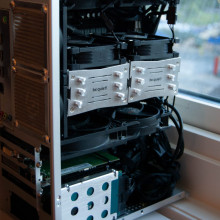
Keeping things cool is helped by drawing fresh air in at the front bottom and blowing hot air out at the back top, cables depart at the bottom in the back. Depending on the heat generated and direction of fans in the computers stored, this setup may also be enough to not necessitate additional fans relying on passive convection and computer airflow.
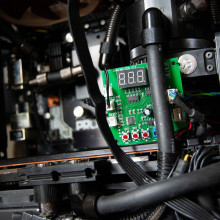
In my case however, I add three 120mm fans at the front and three at the rear (space inside is exactly 360mm), both controlled by a temperature sensor in a separate power board, which allow them to be turned fully of when not needed and progressively ramp up based on temperature. At the front, one is attached to the most sensitive server where most of my home lab activities takes place, running models, trying out virtualized services etc.. The rear is attached to one of the main network computers the UTM (unified threat manager). If any of these two gets too hot it’s essential that the fans ramp up, otherwise their temperature follow the mean of servers inside so will be OK at keeping the average temperatures low as well. Boards such as this can be easily gotten from amazon, eBay or aliexpress for instance, you can power them with a range of voltages. For power You can use any ~5 to 25 dc volt supply, so if you had saved the power plug of old discarded routers, lamps, etc. This is a good source, things often thrown away but still having a use in many applications other than that broken lamp, or that router from an old forgotten Internet provider.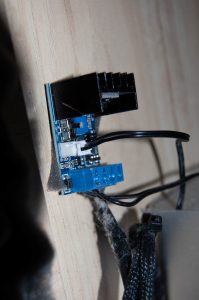
Since I’m interested in both hardware and software none of the many tiny servers inside is loud, important to keep in mind as you may as well use decommissioned ‘real’ servers that, however, limits the number and will bring the noise up to unacceptable levels. In my case all computers are custom built and made with noise in mind. A gentle ‘whoosh’ is present, which does increase somewhat under heavy load, yet with some added sound dampening foam to make up the gaps and fill flat panels, it is really acceptable. So from some IKEA flat packs, wheels, plugs, glue, angle-irons, fans and power supply found in leftover bins, a nice silent cabinet housing a plethora of small and large computers is the result. It is easy enough to manage with KVM- cables, SSH and vnc/remote desktop, a great addition and well spent time!
Homelab: 3 Turning laptops into mini-servers
Homelab: 2 Tiny 24 Core virtualization Computation with hacked hardware
Homelab: 1 25 Year old computer as a firewall: 60Mbps throughput
Continue in this series
More in Homelab & Compute