thelifediy.com
Random Posts
LOAD MORE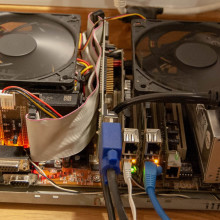
Homelab: 1 25 Year old computer as a firewall: 60Mbps throughput
A test of whether a 25-year-old computer can still serve as a practical pfSense firewall at home, and what performance it can deliver.
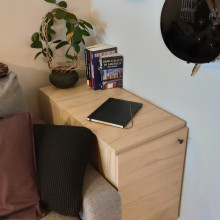
Homelab: 4 Family & apartment friendly server cabinet
A practical homelab cabinet build that makes multiple tiny servers easier to live with in an apartment or family setting.
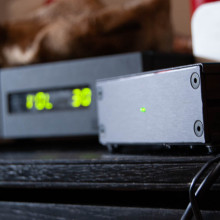
Custom DDC: 1 Digital to Digital Converter; USB to I2S over HDMI; S/PDIF; AES
A DIY digital-to-digital converter build with USB input, improved clocks, and outputs including I2S over HDMI, S/PDIF, and AES.
Silence Your Guitar Amp: Variable Voltage Regulator
Guitarists often find themselves in love with their amps, when playing electric guitar, a lot of what makes up your sound is found far down the chain from your actual strings. And here comes the problem, the best guitar amps are using tubes for amplification, as is common in hifi-gear and can as such be quite unruly, not to mention the best sounding ones are hardly made to play in a house but rather at large stages. There have been many attempts through the years to make these big powerful heavy amplifiers work in small spaces.
A solution with a variable voltage regulator, allow the preamp portion of the amplification to act on high voltages, while the output tubes output transformer and phase inverter gets scaled down in parallel. In the vast amount of modern music guitar amps this best retains the guitar sound at lower volumes.
Here I also manged to find a 1Meg Clarostat potentiometer, exceedingly rare a 2w sealed conductive plastic pot, matching the most ideal pots used in many a high-gain amps. They are also common in some old, very highly priced hi-fi gear and in older professional electronic equipment. (in truth it took me years before identifying a source for these, and in these values)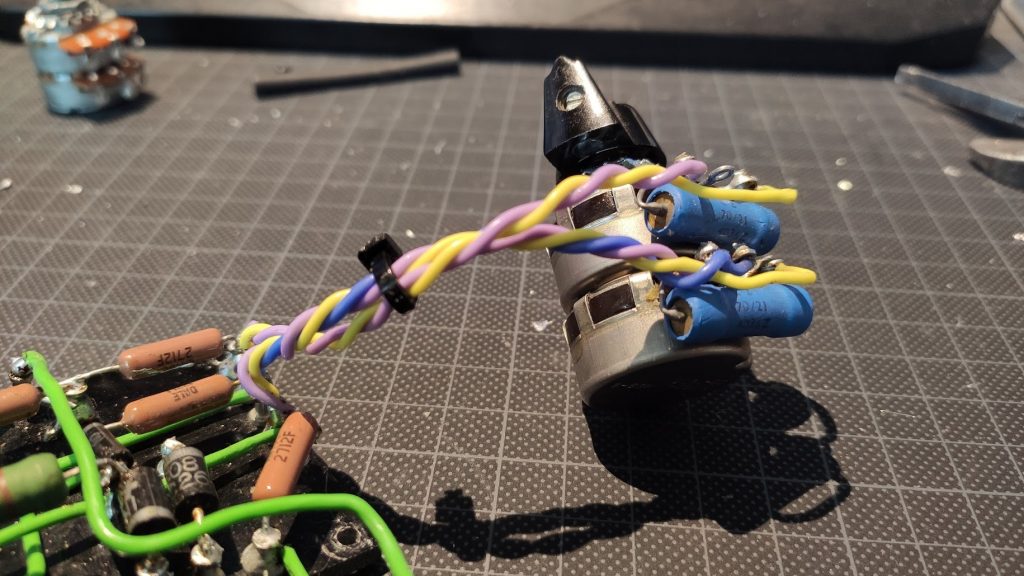 On the other side we see mosfets varying voltage to the amp, the NTE2973 mosfet is becoming rare and alternatives exists that are also easier to come by in europe (this part can in some instances not be exported from the us using the regular sources like ‘mouser’ for instance.)
This is an example in a Soldano 100 would look like this, with the colored section including changes, grey have some unrelated added tweaks.
But why do this? Well, most of the best sounding guitar amps, depending on genre, are made to fill very large venues, and those are generally, by far, the best sounding ones. Since we are talking about very crude early 50-60’s technology, they are hard to handle and while the main volume setting goes from 0 to 10 (or 11), many gets out of hand even for a small rehearsal space at 1.1, others only start sounding, good or, how they are supposed to at 3-5, while 1 is already to loud. Imagine getting this to work in a home setting, however with a VVR when power-amp distortion is not of interest, with this you can now use them even in a home-office..
More in this section
More in Guitar Amplifiers & Hi-Fi