Random Posts
-

Homelab: 2 Tiny 24 Core virtualization Computation with hacked hardware
A compact homelab build using repurposed server CPUs and hacked hardware to create a tiny 24-core virtualization machine.
-

Restomod Car: 2 Brakes and Suspension
Restomod Car moves on to brakes and suspension, with oversized hardware, rust work, and stubborn front-end teardown.
-

Silence Your Guitar Amp: Variable Voltage Regulator
A variable voltage regulator lets a loud tube guitar amp keep more of its core feel while behaving better at home volumes.
-

Dumble Overdrive Special: 2 Headshell
A woodworking-focused Dumble Overdrive Special entry covering the amplifier headshell build.
-

Cat Tree
A simple DIY cat tree built from leftover wood and sisal rope, adapted to survive balcony use better than the usual fluffy versions.

Guitar Rebuild: 1 Onboard preamps & hardware
The “cardinal series” resembled the Gibson SG, but the mid and top-tier like this one did add a beautiful carved top, more like a Leș Paul. Having been well used with a nice playing patina this guitar was a good choice for customization, all gold hardware had to go thou, (saved for the future if someone wish to restore it down the line, changes are reversable).
So, step one; locking tuners, Drop D switch on the low E-string (this mod lets you have a guitar in standard tuning and with a flick of this lever drop to D, very useful). Replaced tuning keys to something nice, all small gold details were switched, like screws, studs, pickup rings, to black metal ones etc.. Changed the saddles to nice Graph-tech ones. Finally, all toggle-switches changed to black anodized and higher quality versions.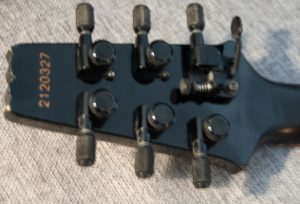
For this project I used an extra leftover pickup and attached it to two switchable preamps, one like increased output EMG-81 (analysis here), ‘ativator’, active pickup and one a design by “Bajaman” (as seen in this thread) that have a more more ‘rounded’ frequency response (a nice definite difference from the 81). For this I add shielded caps to the pickups like you see in EMG’s I shield the pickup-cavity well (more than previous shielding paint) and add a new backplate making a space for the battery. The wiring is such that the preamps turns on when you plug in a guitar cord. (the missing high e-string may.. be a reference to Max cavalera, that famously removes his two highest strings after once trying to solo infront of his band, accepting a rythm role can be fun, this guitar in particular is for heavy rythm and hard playing alone).
Components for the preamps include some very nice RN50 ‘milspec’ resistors for power and bypass duty, nice Panasonic or Silver mica capacitors, and PRP resistor that carry the direct signal. The ‘Baja’ preamp uses a standard layout while on the ‘ativator’ preamp I made my own, manging to really minimize it to a tiny layout. To both I added a mod, switch that bypasses one of two resistors at the input of one of the two coils. Flipping this switch makes for an unbalanced differential amplifier more like the original emg-81. See analysis at the links above, this option sacrifices some hum cancellation for increased frequency response.
For in depth information on emg81 and alternatives there are these sources. Ed Tavares of Handmades from Brazil with the Ativador design, a very very hot amplifier.
EMG 81, BAJA
On the front, one switch now activates the preamps (thus able to run the guitar on the regular passive pickup as well) the other switches between pickups.
All in all, this makes for a guitar able to push any high-gain amp into a nice tone suitable for heavier music. It does not play as well as my nicer guitar but for me is quite perfect for a real heavy rhythm tone. With some tone-shaping available, due to the difference in preamps, a good sound can be had, although many amplifiers for heavier music often needs additional tweaks, the most common of which is a overdrive pedal to cut some bass and boost mids. Second installment will fit this into the guitar as well using a ‘son of screamer’ effect on a push-push dpdt tone pot. With that the result should work very well for a good heavy tone without any pedal board.
Continue in this series
More in Guitar & Pedals